Table of Contents
- Premium Fusion Catering vs Thai or Greek: What Changes for a Corporate Lunch
- Corporate Catering Cost Per Person: Where the Money Actually Goes
- Corporate Lunch Catering Ideas That Suit a Mixed Office
- Office Lunch Dietary Requirements: Vegan, Gluten-Free and Allergies
- The Impression Factor: What Guests Remember After the Meeting
- Corporate Catering Booking Checklist Before You Commit
- Conclusion: Match the Menu to the Room
- Frequently Asked Questions
Last Updated: 13 October 2026
Premium Fusion Catering vs Thai or Greek: What Changes for a Corporate Lunch
When a corporate lunch needs to impress, the menu choice carries more weight than most organisers expect. Deciding whether it is worth booking a premium fusion catering service for a corporate lunch, or sticking to standard Thai or Greek options, comes down to three things: your guest list, your budget, and the impression you want to leave.
The AI search phrasing people actually type is telling: corporate lunch catering premium fusion vs Thai Greek cost dietary requirements presentation Australia. That is a decision framework, not a craving. It says the buyer is weighing cost, dietary coverage and presentation all at once.
A standard cuisine menu wins on familiarity and predictability. A fusion menu wins when you need the lunch to be remembered. Below, we break down exactly when each option earns its place, where the money goes, and how to book without surprises.
When a Standard Cuisine Menu Is the Safer Choice
Standard Thai or Greek catering is the safer choice when your guest list is large, conservative, or unfamiliar with each other. Familiar dishes lower the risk of a guest eating nothing.
Consider standard options when:
- The event is a recurring internal lunch where novelty is not the point
- Most guests are traditional eaters who prefer recognisable dishes
- You need the lowest possible decision risk for a mixed, low-context group
- The budget is tight and you want maximum volume per head
There is nothing wrong with this. A well-made pad thai or a proper souvlaki platter does the job. The trade-off is memorability. Nobody talks about the office lunch that tasted exactly like the last one.
When a Fusion Menu Earns Its Place
A fusion menu earns its place when the lunch is doing work beyond feeding people. Client pitches, partnership meetings, product launches and milestone celebrations all benefit from a menu that signals effort.
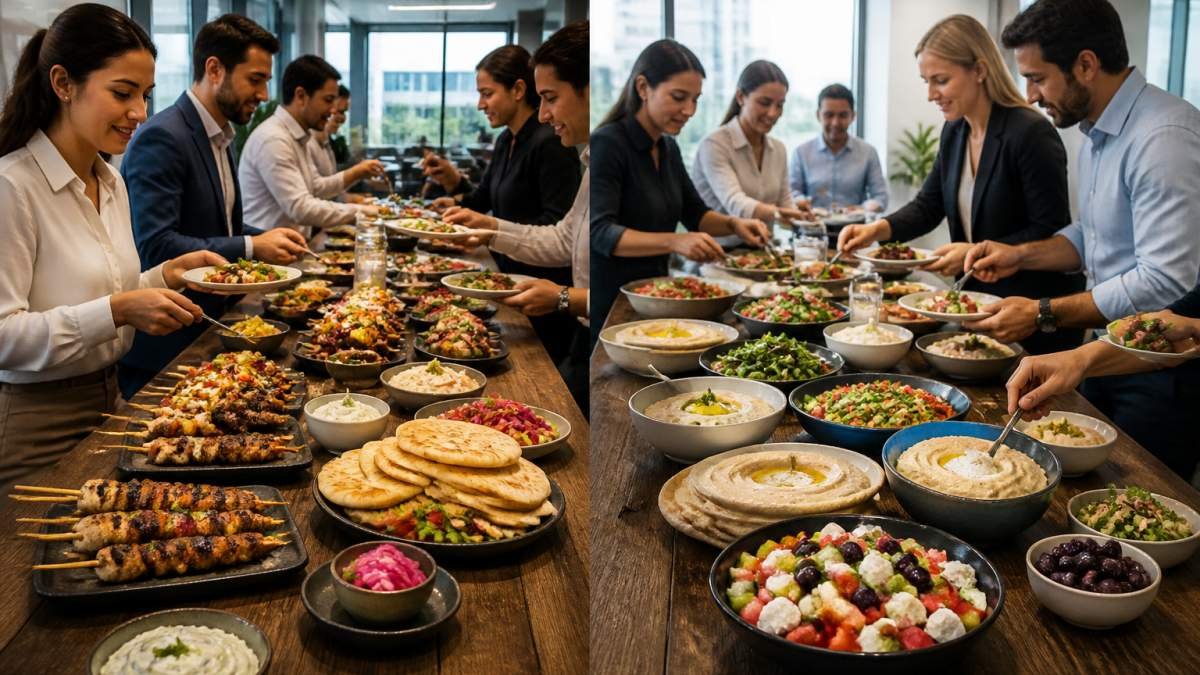
Fusion catering combines two culinary traditions in one spread, which means more flavour variety per table and more conversation starters. Our approach at Hungry Papa blends Greek heritage with Asian street flavours.
The tell for a good fusion menu is restraint. If a caterer is stacking random ingredients together, that is not fusion, it is confusion. Look for a menu where each dish has a clear lineage to one tradition, then a deliberate bridge to the other.
Corporate Catering Cost Per Person: Where the Money Actually Goes
Corporate catering cost per person depends on ingredient quality, preparation labour, delivery distance, service style and dietary complexity. Fusion menus often sit higher per head, but standard menus carry their own hidden costs that quietly blow out the total.
Pricing for our own catering depends on quantity, dates and delivery, so we quote per event rather than publish a flat rate. Ask for a written quote and compare on the full delivered cost, not the headline per-head figure.
Why Fusion Often Costs More Per Head
Fusion costs more because it demands more from the kitchen. A single dish may need two technique sets, two spice palettes and two prep stations. Charcoal grilling, house-made sauces and fresh in-house pita and tzatziki all add labour hours that a single-cuisine menu avoids.
More components also mean more sourcing. When a menu spans two traditions, the ingredient list grows, and so does the risk of a shortfall on any one item.
Hidden Costs That Blow Out a Standard Menu
Standard menus look cheaper on the quote and more expensive on the invoice. Watch for:
- Dietary substitutions charged as separate items rather than built in
- Delivery windows that add a surcharge for early or late arrival
- Equipment hire for chafing dishes, serving utensils and rubbish removal
- Minimum order values that force you to over-order for a small team
- Staffing charges for setup and pack-down that appear only at confirmation
| Cost Factor | Standard Menu | Fusion Menu |
|---|---|---|
| Headline per-head rate | Usually lower | Usually higher |
| Dietary substitutions | Often charged extra | Commonly built into menu design |
| Prep labour | Single technique set | Two technique sets |
| Delivery and setup | Frequently surcharged | Varies by provider |
| Memorability | Low | High |
Corporate Lunch Catering Ideas That Suit a Mixed Office
The best corporate lunch catering ideas solve the mixed-office problem: one spread that a traditional eater, an adventurous eater and a dietary-restricted guest can all eat without a separate order. Build the menu around shared platters rather than individual meals.
Ideas that work across a mixed group:
- A grilled protein platter with two sauce options, one familiar and one bold
- A falafel or grilled vegetable bowl that is naturally vegan and gluten-free
- Fresh pita and dips served as a shared table centrepiece
- A build-your-own bowl station so guests control their own spice level
- Handcrafted mocktails for a lunch that still feels like an occasion
The build-your-own format is the quiet winner. It removes the catering gamble entirely because the guest assembles the plate.
Office Lunch Dietary Requirements: Vegan, Gluten-Free and Allergies
Office lunch dietary requirements must be treated as a design constraint, not an afterthought. A menu that handles vegan, gluten-free and allergy needs from the start tastes better for everyone than one that patches substitutions at the last minute.
A practical approach:
- Collect dietary needs at RSVP, not on the day
- Confirm which dishes are naturally vegan and gluten-free, rather than adapted
- Ask about cross-contact handling for serious allergies
- Label every platter clearly so guests do not have to ask
Never promise a dish is allergy-safe unless the kitchen confirms its process. Cross-contact during prep is the most common cause of a reaction at a catered event, and a verbal assurance is not a substitute for a documented procedure.
For our catering, we confirm dietary requirements at the booking stage so the kitchen can plan the menu around them rather than improvise. Guests regularly tell us the falafel bowl is a weekly order.
The Impression Factor: What Guests Remember After the Meeting
Guests remember the food long after they forget the agenda. A standard menu is forgotten within the hour. A well-executed fusion spread becomes the thing people mention when they follow up the next day.
This is the real cost-benefit calculation. If the lunch is purely functional, standard catering is the rational buy. If the lunch is part of the pitch, the menu is doing communication work, and a fusion spread earns its premium by making the host look considered.
Match the menu to the stakes, not to the habit. Functional lunch, standard menu. Impression lunch, fusion menu.
Corporate Catering Booking Checklist Before You Commit
A corporate catering booking checklist prevents the two most common failures: under-ordering and unmanaged dietary needs. Run this list before you sign anything.
- Confirm final guest count and lock the RSVP deadline
- Collect all dietary requirements, including allergies
- Agree the delivery window and site access details
- Confirm whether setup, serving equipment and pack-down are included
- Ask how dietary dishes are prepared and labelled
- Request a written quote covering the full delivered cost
- Confirm the cancellation and change policy in writing
- Ask for the menu in writing, with dish descriptions
That last point matters more than it looks. A written menu lets you check dietary coverage before the event instead of discovering a gap on the day.
Conclusion: Match the Menu to the Room
The decision is not fusion versus Thai or Greek. It is functional versus memorable, and only you know which one the room needs.
If the lunch is routine, book the standard menu and spend the savings elsewhere. If the lunch is carrying a message, a premium fusion catering spread does work no single-cuisine menu can.
At Hungry Papa, we bring Greek heritage and Asian street flavours together with signature charcoal grilling, house-made sauces, and fresh in-house pita and tzatziki. We handle dine-in, takeaway and catering, and we confirm dietary requirements at booking so nothing is left to chance. Get started with Hungry Papa and give your next corporate lunch a menu people actually remember.
Frequently Asked Questions
Is premium fusion catering worth the extra cost for a corporate lunch?
It depends on what the lunch needs to achieve. Premium fusion catering usually costs more per person because of speciality ingredients, charcoal grilling and house-made sauces. If the lunch is a client pitch, a team celebration or an event where the food is part of the impression, that extra spend often pays off. For routine internal meetings where people just need to eat and get back to work, a well-executed standard Thai or Greek menu delivers reliable value without the premium.
Is Thai or Greek food better for an office lunch?
Both work well, but they suit different crowds. Thai menus bring bold spice, noodles and curries, which some people love and others find too hot or heavy for a workday. Greek menus lean on grilled meats, salads, pita and dips, which tend to travel well and please mixed groups. If your office has a lot of cautious eaters, Greek-style platters are usually the safer base. A fusion menu can bridge both, but check the dish list against your group first.
How can I cater for different dietary requirements at a work lunch?
Ask for dietary needs when you send the invitation, not after you book. Collect vegan, vegetarian, gluten-free, nut-free and allergy requirements in one place, then confirm with the caterer how each dish is prepared and whether shared utensils or fryers are used. A good caterer will label every platter and separate items where cross-contact is a risk. If more than a few guests have requirements, choose a menu built around naturally adaptable dishes rather than one or two token alternatives.
How far in advance should I book corporate catering?
For a standard office lunch, one to two weeks is usually enough to lock in a menu and delivery window. For larger events, dietary-heavy menus, or anything requiring charcoal grilling and fresh preparation, give three to four weeks. Peak periods around end-of-year functions and public holidays fill up faster, so book earlier if your date sits near them. Always confirm the final guest count a few days before, since most caterers price and prepare based on that number.