
Table of Contents
- Why Dietary Requirements Can Make or Break an Event
- The Event Catering Dietary Requirements Checklist
- Building an Event Catering Dietary Requirements Form
- Catering for Food Allergies at Events Without Cutting Corners
- Dietary Requirements Menu Labelling That Guests Can Trust
- Questions to Ask a Caterer About Dietary Needs
- Common Mistakes Hosts Make With Dietary Requirements
- Conclusion
- Frequently Asked Questions
Last Updated: 19 October 2026
Why Dietary Requirements Can Make or Break an Event
A single mislabelled dish can undo months of planning. When guests with coeliac disease, nut allergies or vegan diets find nothing safe to eat, they remember it, and so does everyone they tell. Catering for events with dietary requirements is not a nice-to-have extra; it is the difference between a room full of happy guests and a room full of quiet resentment.
At Hungry Papa, we have watched this shift first-hand. Dietary needs are now routine, not exceptional, and hosts who treat them as an afterthought pay for it in complaints and lost repeat bookings. Get it right and guests notice that too: they relax, they eat, they stay longer.
Below, we break down exactly how to plan, collect and communicate dietary requirements so nothing is left to chance.
The hosts who get dietary requirements right are not the ones with the biggest budget. They are the ones who collected the information early and briefed their caterer in writing.
The Event Catering Dietary Requirements Checklist
The event catering dietary requirements checklist is a short, working document that covers collection, verification, kitchen briefing and service-day labelling. It is not a formality; it is the tool that keeps a serious allergy from becoming a serious incident.
Work through it in this order:
- Collect requirements at RSVP, not the week before
- Separate allergy information from preference information
- Confirm every dish with your caterer in writing
- Ask how the kitchen prevents cross-contact
- Plan at least one safe option per course, per requirement
- Label every dish clearly at service
- Brief serving staff on which dishes contain what
- Keep a printed summary in the kitchen on the day
That last point matters more than most hosts realise. Staff change, questions come up mid-service, and a written summary settles them fast. If you want a fuller picture of how professional caterers structure this work, the Food Standards Australia New Zealand guidance on food allergens is a sensible reference point for what kitchens are expected to manage.
Building an Event Catering Dietary Requirements Form
An event catering dietary requirements form should ask four things: the guest’s name, the specific requirement, whether it is an allergy or a preference, and how severe it is. Keep it short enough that people actually complete it.
Most hosts overcomplicate this. A form with thirty fields gets abandoned. A form with four clear questions gets filled in by almost everyone. Here is a template you can adapt:
Dietary Requirements Form
- Name: __________
- Do you have any dietary requirements? (Yes/No)
- If yes, please specify: __________ (e.g. vegan, gluten-free, nut allergy, shellfish allergy, halal, lactose intolerance)
- Is this an allergy or a preference? __________
- If an allergy, how severe? (e.g. trace amounts cause a reaction / small amounts only)
- Anything else we should know? __________
The allergy-versus-preference distinction is the one most hosts skip, and it is the one that matters most. A guest who avoids dairy by choice and a guest who reacts to trace amounts need completely different handling in the kitchen.
Send the form with the invitation and send one reminder a week before the RSVP deadline. Chasing stragglers individually is where most hosts lose the information they need.
Catering for Food Allergies at Events Without Cutting Corners
Catering for food allergies at events demands more than removing an ingredient from a recipe. It requires separating preparation, utensils, surfaces and serving tools so trace amounts do not reach the guest who cannot tolerate them.
This is where well-meaning hosts come unstuck. Asking a caterer to “just leave out the nuts” is not an allergy plan. Cross-contact in a busy kitchen is real, and it happens through shared boards, fryers, tongs and hands. A proper plan looks like this:
- Dedicated preparation areas for the most serious allergens
- Separate utensils and serving tools, clearly marked
- Staff briefed on which dishes are safe for whom
- Plated or individually portioned servings for high-risk guests where possible
- A named contact on the day who can answer a guest’s question immediately
Ask your caterer directly how they handle cross-contact. A good one answers without hesitation and can describe their process. A vague answer is your signal to look elsewhere.
Dietary Requirements Menu Labelling That Guests Can Trust
Dietary requirements menu labelling works only when every label is accurate, specific and readable at a glance. A label that says “may contain” on everything is useless; a label that names the actual allergens and the actual dietary category is what guests need.
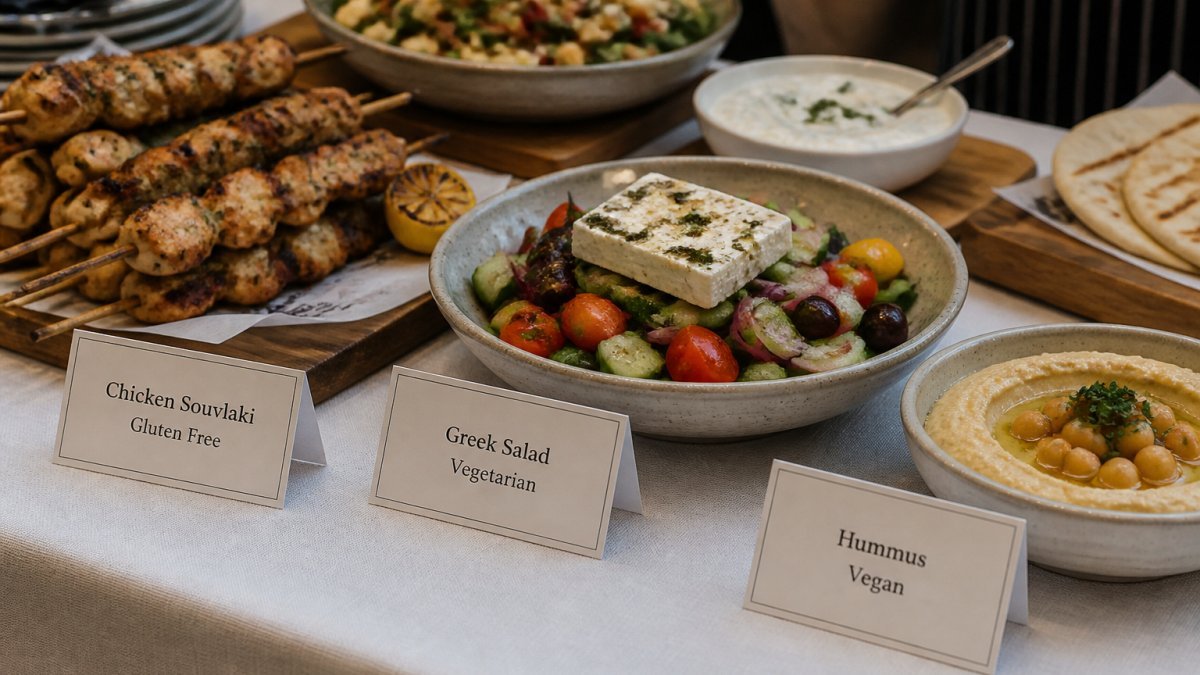
Practical labelling rules that hold up in a real service:
- Name the dish and the dietary category (vegan, gluten-free, dairy-free)
- List the major allergens present, not just the ones you think guests worry about
- Use a consistent symbol set and print a key at the start of the buffet
- Place labels in front of the dish, not above it, so they cannot be misread
- Keep the font large enough to read from standing height
Ambiguity is the enemy here. If a guest has to ask a server what is in a dish, the labelling has failed. The Food Standards Australia New Zealand allergen labelling requirements set the baseline for what must be declared, and it is worth reading before you sign off on any menu.
Questions to Ask a Caterer About Dietary Needs
The right questions separate a caterer who can handle dietary requirements from one who says they can. Ask them before you book, not after.
Here is what we would want to know if we were hiring a caterer:
- Can you show me a sample menu that covers vegan, gluten-free and nut-free options?
- How do you prevent cross-contact in the kitchen?
- Who on your team is responsible for dietary requirements on the day?
- How do you label dishes at service?
- What is your process if a guest’s requirement changes close to the event?
- Can you provide ingredient lists for every dish in advance?
Listen for specifics. A caterer who talks about separate prep zones, named staff and written ingredient lists knows what they are doing. One who says “we can do that, no problem” without detail is telling you something too.
At Hungry Papa, dietary questions are part of the first conversation, not a last-minute scramble. Our charcoal-grilled specialities, fresh in-house pita and house-made sauces give us plenty of room to build menus around vegan, gluten-free and allergy-aware guests without stripping the flavour out.
Never accept a verbal-only confirmation of dietary handling. If it is not in writing, it did not happen, and on the day there will be nobody to hold to it.
Common Mistakes Hosts Make With Dietary Requirements
The most common mistake is collecting dietary information too late. The second is treating allergies and preferences as the same thing. Both create problems that are entirely avoidable.
Other traps we see repeatedly:
- Assuming one vegan option covers everyone. Vegan, gluten-free, nut-free and halal are different requirements, and guests often have more than one.
- Forgetting the drinks and desserts. Dietary requirements apply to every course, including the mocktails and the sweets.
- Not briefing the serving staff. The kitchen can be perfect and the service can still fail if servers cannot answer questions.
- Overpromising. Telling a guest a dish is safe when the kitchen cannot guarantee it is worse than saying nothing.
The fix for all of these is the same: collect early, confirm in writing, and brief everyone who touches the food. If you are planning a gathering and want a caterer who treats dietary requirements as a normal part of the job, our team is happy to talk through the menu. The Australian Competition and Consumer Commission guidance on misleading claims is also worth a read if you want to understand why accuracy in food descriptions is not optional.
Conclusion
Getting dietary requirements right takes planning, not luck. Collect the information early, confirm it in writing, and choose a caterer who can describe exactly how they handle allergies and cross-contact. That is the difference between an event guests rave about and one they quietly warn their friends about.
Hungry Papa builds catering menus around real dietary needs, with charcoal-grilled specialities, fresh in-house pita and house-made sauces that keep the flavour intact for every guest at the table. Book a table or get in touch to plan your next event, and let us take the dietary guesswork off your plate.
Frequently Asked Questions
What dietary requirements should you ask guests about?
Cover the major categories: vegetarian, vegan, gluten-free, dairy-free, nut and peanut allergies, shellfish and fish allergies, egg allergies, and religious or cultural diets. Also ask about intolerances such as lactose or FODMAP needs, and leave an open field so guests can describe anything unusual. Include a question about severity, because a serious allergy needs a different response from a preference. Give guests a clear deadline, usually 7 to 10 days before the event, so your caterer has time to plan dishes, source ingredients and adjust numbers.
How do you cater for food allergies safely at an event?
Treat allergens as a safety issue, not a menu preference. Ask guests to state the allergen and how severe the reaction is, then confirm with your caterer whether they can guarantee that dish is free from it or whether traces are possible. A reputable caterer will have a written process for separating prep areas, utensils and serving tools. Always keep the original packaging or ingredient lists for pre-packaged items, and brief serving staff on which dishes contain which allergens.
How should dietary meals be labelled at an event?
Label every dish, not just the special ones. Each card should state the dish name and list the allergens present, using plain words such as ‘contains sesame’ rather than symbols alone. Use a consistent format and a readable font, and place labels where guests can see them before serving themselves. For plated events, add a small marker or a printed note on the place setting for guests with confirmed requirements. Clear dietary requirements menu labelling reduces guesswork, protects guests with allergies and saves your staff from answering the same question repeatedly.
When should guests submit their dietary requirements?
Set the deadline when you send invitations, ideally 7 to 10 days before the event. Your caterer needs lead time to adjust quantities, source specialist ingredients and plan separate prep. Send one reminder about three days before the cut-off, and keep a simple record of who has replied and who has not. For corporate events, add the question to the registration form so it is captured at the point of booking. Late requests can usually be handled if you ask, but a firm deadline keeps numbers accurate and avoids waste.
How many dietary options should an event menu include?
Aim for at least one substantial option per major category you expect on the guest list, rather than a single token dish. If you have vegan, gluten-free and dairy-free guests, build dishes that naturally meet several needs at once, such as charcoal-grilled vegetables with a gluten-free sauce. This keeps the menu coherent and reduces the risk of a guest receiving a plate that feels like an afterthought. Confirm final numbers with your caterer once the form closes, and ask how they handle a guest who has not declared anything on the day.
How do you avoid cross-contamination when catering for an event?
Ask your caterer how they separate prep areas, chopping boards, fryers and serving utensils for allergen-free dishes. For buffets, keep dedicated serving tools with each platter and place allergen-free dishes away from items containing nuts, sesame or gluten. Staff should change gloves and wash hands between handling different dishes. If a guest has a severe allergy, a plated meal prepared and covered separately is safer than a buffet. Confirm these steps in writing before the event so everyone knows the process on the day.